
Modern and Postmodern
Reading Fredric Jameson

This week, I want to tell you about something I read a couple of years ago, but that has been stuck in my head ever since. It’s become a rubric, of sorts, for how I think about a lot of other things—especially modern and contemporary art—and it’s very much in the background of what I’ve been writing about on Symbol Factory.
What are “modernism” and “postmodernism?” In the last chapter of Postmodernism, or, The Cultural Logic of Late Capitalism, Fredric Jameson offers the clearest and most illuminating account of the two that I’ve ever come across.
First up, modernism. The material hallmarks of the modern world (high technology, the market economy, mass industrial production, etc.) didn’t come about all at once in any given society. Modernization was always a matter of “uneven development”—the coexistence of new and old elements. A European city in the early 20th century might have, for instance, assembly-line factories and electric streetlights, but also horse-drawn carriages, cobblestone streets, and other holdovers that had been around for hundreds, if not thousands, of years. To look around in a modernizing society was to see examples of the new alongside examples of the old. That confrontation between new and old is characteristically“modern,” and “modernism” in art and thought explores that confrontation.
Let’s illustrate.1 “Modern art,” Jameson writes, “drew its power and possibilities from being a backwater and an archaic holdover” in a modernizing world. Modernist painters were an intentional anachronism—one-person combinations of new and old. For one thing, the way they did their work (their mode of production, if you will) was a holdover from an earlier time. They were individual craftsmen making something with their hands at a time when mass production, characterized by lots of people doing unskilled tasks with heavy involvement by machinery, was coming to dominate other forms of labor.
And speaking of machines, there’s an even bigger way the modern artist represented a confrontation between new and old: the problem of the camera.2 Choosing to paint at all, given the existence of this image-making machinery, was itself an assertion of something old. But one couldn’t simply go on painting as if the photo camera had never come along, because the camera raised existential questions for painting. If painting is nothing more than the production of two-dimensional images that look like a thing or a person or a scene, then the camera renders it entirely obsolete and there’s no point in painting anymore.
To assert the value of this old activity, to not be simply redundant to the camera, the artist would have to explore what else painting can be—or rediscover what painting really was all along. There are lots of movements we can lump under the “modernist” label (cubism, symbolism, primitivism, abstract expressionism, etc.), but modernist painters all aimed to do something old in a new way, or something new with an old medium.
This insight has become my guide through a lot of museums of modern and abstract art, especially from the late-19th and early-20th centuries. Works of art from this period are trying to figure out what painting, as an activity, can do—other than merely represent in two dimensions how something looks from a single perspective. Primitivists like Paul Gauguin tried to recapture the significance visual art had in the distant past, or still had in societies where modernization was not so far along. Wassily Kandinsky developed a language of visual symbols that “says” what words can’t, that tries to relate concepts in ways foreign to, or that would be diminished by, written words and literal depictions of concrete objects. Pablo Picasso’s analytical cubism asks whether painting is capable of representing three-dimensional space, compositing lots of mini-snapshots of objects from different perspectives. When looking at a piece of modern art, start by asking, “what is this doing that a photo couldn’t?” The immediate answer, tautological as it may be, is always part of the point: this painting is being a painting, which a photo can never be.
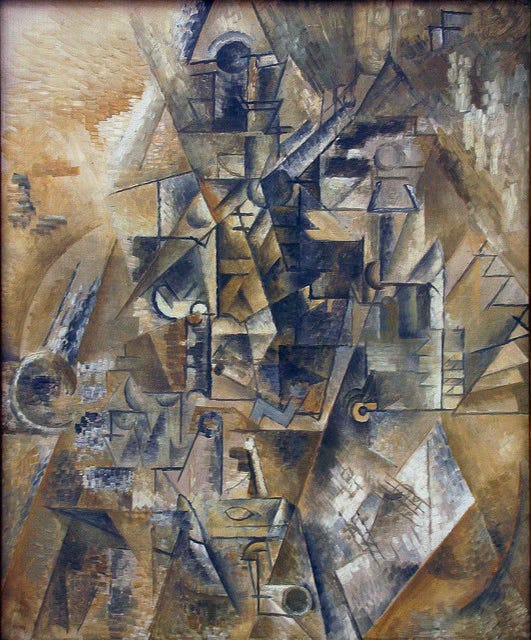
So if modernism is the confrontation between new and old, what does that make postmodernism?
Postmodernism is about the complete victory of newness: “a situation in which the survival, the residue, the holdover, the archaic, has finally been swept away without a trace,” Jameson says. By now, modernization has overtaken every aspect of life. There are no more horse-drawn carriages or handicraft shops on city streets, except as commodified boutique experiences:
Even the surviving historical monuments, all cleaned up, become glittering simulacra of the past, and not its survival. Now everything is new; but by the same token, the very category of the new then loses its meaning and becomes itself something of a modernist survival.
The old is gone. The “general reformation” the Rosicrucians promised centuries ago has happened. There is nothing left to remake, nothing left outside the market or untransformed by modern technology and social structures (i.e., capital and the state). “Everything is now organized and planned; nature has been triumphantly blotted out, along with the peasants, petit-bourgeois commerce, handicraft, feudal aristocracies and imperial bureaucracies.” Everything is a commodity, every corner of the Earth has been forcibly opened to capital, and multinational corporations string every country into a single supply chain. There is nowhere left for the old to hide.
Maybe that sounds bleak, but don’t blame it on postmodernists. They aren’t the reason the world is like this. They’re just telling you what they see (or rather, what you see) and trying to make the best of it. Postmodernism embraces the newness, the immediacy, the all-at-onceness of our situation, trying to find ways to reassert human agency. Postmodernists embrace not only the photo camera, but other “new” ways of making symbols, like film, screen printing, installation art. Jameson identifies postmodernism’s engagement with these technologies as a “rediscovery of production.” What does that mean? Well, that’s what Symbol Factory is about.
What I like about Jameson’s taxonomy is that it reveals the postmodern as a fulfillment of the modern, not a revolution away from it.3 More importantly, it extends the discussion beyond aesthetics and semiotics. Modernism and postmodernism aren’t just art styles or ideologies; they’re reflections of life as we experience it. Contrary to popular views of modern art as purely “subjective,” Jameson shows that modern art is always, on some level, about modernization as a historical, social, even economic process. Postmodern art is even more clearly a reflection of its time—designed to replicate the dizzying, disorienting situation of a world where everything appears to us as pre-processed commodities, where symbols only ever refer to other symbols.
This is all another way of describing the situation Symbol Factory is talking about (which I can now confidently call “postmodern”). What the internet gives us is only the most intense example of the barrage of newness. To restate a problem we posed a couple of weeks ago, we have no way to ground or contextualize new symbols in light of old paradigms, to move between new and old, because the old is gone. Our world of digital symbols is a world of commodities. All the world’s a Symbol Factory.
All hope is not lost, though. The way out, I think, is through that “rediscovery of production” Jameson mentioned. We’ll discuss that more soon…
But first we’re getting raptured. Tune in next week.
pun intended
yes, there were photographic artists among the modernists, but they loved taking photos of old things, juxtaposing the new and the old, and illustrating the process of modernization, i.e. the invasion of the new into the old (see Alfred Stieglitz’s A Snapshot, Paris or Old and New New York).
“Revolution” being, of course, a hopelessly modern concept that has no home in a postmodern world. Early moderns started a trend of breaking history into discrete chunks (“savagery,” “barbarism,” “civilization”; “feudal,” “capitalist,” “socialist”; “premodern,” “modern,” “postmodern”). But ever since 1989 or so, we’ve definitively broken from the idea of definitive breakage, having reached “the end of history and the last man”—total newness, the eternal now, history’s final stage.
A thought. In my youth, I encountered a very simplified narrative of art: There is the "traditional," which is in conversation with the past and really only considered art inasmuch as it reaches back into the past, and there is the "modern," which is inherently bad and anti-nature/nominalist.
This is simply not true. Art has never been stagnant. Conservatives look at medieval art like it's pastiche and miss the major innovations in perspective, the political subtext of including patrons in the art, changing depictions of the Holy Family, etc. They think the Renaissance was just a rediscovery of the ancient world, when in fact it's an entirely novel perspective (and reinterpretation) of the ancients--one which is in fact pretty discontinuous with the original context!
The past is a key ingredient in what makes the art intelligible but it's not the only ingredient in making and interpreting art! If you always assume that novelty is automatically discontinuity or rupture, you are missing the conversation that is going on within the piece.